FORBES - Tribute To Photographer Olivier Dassault
An exhibition in Luxembourg celebrates Olivier Dassault’s captivating photographic legacy, where light meets abstraction and emotion
by Stéphanie Breydel de Groeninghe 15 August 2025

Discover the vibrant world of the late Olivier Dassault in Abstract Expressions, a striking photography exhibition at BIL Luxembourg, blending light, abstraction, and emotion until 18 July 2025.
A man of many talents, Olivier Dassault discovered his passion for photography as a teenager in the 1960s. A pilot, Member of Parliament, business leader, and holder of a doctorate in mathematics and computer science, the Frenchman remained devoted throughout his life to capturing moments on film using his trusted Minolta XD7. Over the years, this passion evolved into a fully-fledged artistic career. Dassault’s sharp eye—shaped by his experience as a pilot—and his refined sense of observation were essential to his approach. Light was his mantra, and the camera his paintbrush.
His photographs have been exhibited across the globe—from Paris to New York, Madrid to Marrakech, and Brussels—and will continue to be shared with audiences worldwide thanks to the dedication of his wife, Natacha Dassault. His work features in the collections of major museums and institutions, including the Bibliothèque Nationale de France, the Israel Museum in Jerusalem, the Museum of Fine Arts in Houston, Texas, and the Palm Springs Art Museum in California. In 2023, his oeuvre was added to the prestigious collection of the Centre Pompidou in Paris.
Though Dassault held significant political responsibilities as an MP in the French National Assembly and occupied high-ranking roles within the Dassault Group, it is his artistic legacy that truly sets him apart. His approach to photography was a constant pursuit—an obsessive quest for the ultimate and unique shot. His “iconic confessions” reflect his mischievous spirit, emotional sensitivity, and technical virtuosity.
Enriched by the cultural and artistic education instilled by his mother, Dassault’s creative vision drew inspiration from major artistic movements. His early works, with their soft-focus portraits and pastoral landscapes, evoked Impressionism, while his later urban and natural compositions veered toward Hyperrealism. A lover of the human form, he began his artistic journey by photographing renowned actresses such as Isabelle Adjani, Jane Birkin, Isabelle Huppert, and Carole Bouquet. His lens later turned to architecture, both ancient and modern—from the pyramids of Egypt to the skyscrapers of New York, via the alleyways of Bangkok and Venice.

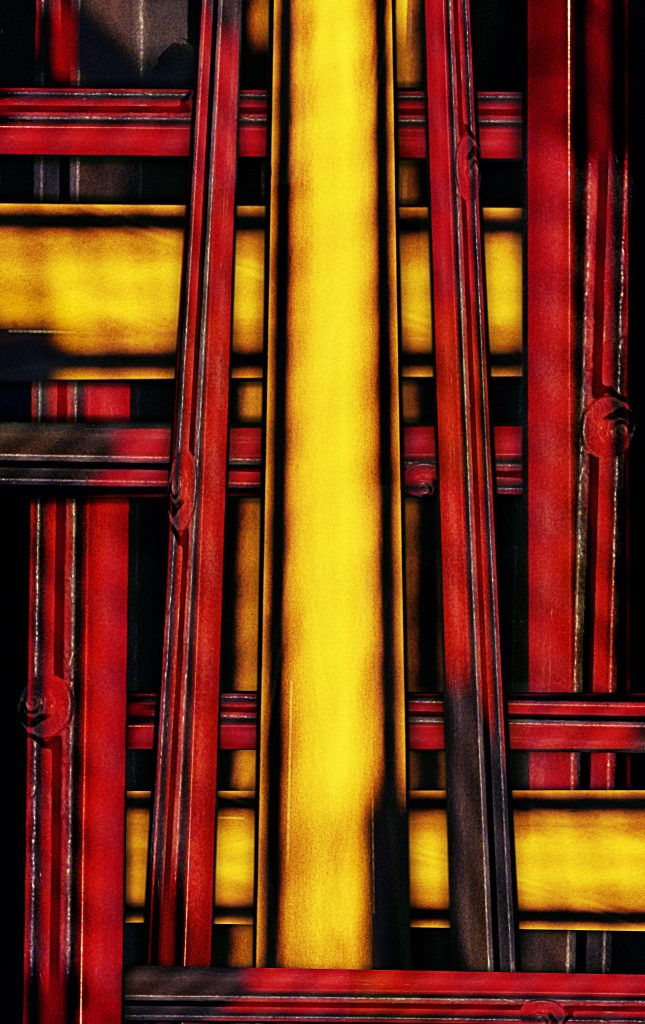
In the last 25 years of his life, he moved away from realism, exploring spontaneous abstractions and improvised compositions through the technique of multiple exposures.
“Superimposition is a way of sublimating a subject that, at first glance, might seem ordinary. Technically, I take several photographs of the same subject on a single roll of film,” he explained.
Known for his cheerful disposition, Dassault infused rhythm and colour into his reconstructed visions. Everything inspired him: a piece of graffiti on a wall, a scarf in a boutique window, a chiaroscuro in the forest, or the interplay of shadow and light on a manhole cover.
“Everything inspired him: a piece of graffiti on a wall, a scarf in a boutique window, a chiaroscuro in the forest, or the interplay of shadow and light on a manhole cover”
In this sense, Olivier Dassault aligns with the tradition of photographers like Ray K Metzker, Alfred Stieglitz, Harry Callahan, and Edward Steichen, for whom abstraction was not about distortion but about affirming photography as an independent art form.
“Photography is also a medium, like a screen, that delivers insight into the state of the world, regardless of the personal interpretation projected onto it. The viewer may, one hopes, find aesthetic pleasure—but beyond that, they may also perceive the fleeting moment of its conception and the message it conveys. This creates a brief, meaningful exchange with the photographer, who, like the viewer, seeks to make sense of the world. That is all I wish for—this sharing.”
Around forty of Dassault’s photographs are currently on display in the Galerie Indépendance, the dedicated art space within Banque Internationale à Luxembourg (BIL) on route d’Esch in Luxembourg-Merl. Since its opening in 1995, the gallery has hosted more than 80 exhibitions, reflecting BIL’s long-standing commitment to fostering creativity and culture.

Olivier Dassault, the artist, above all cherished the art of encounter—especially with light. His creations gained volume and vitality through intricate plays of transparency. He also explored colour as a source of energy, working across various chromatic scales to give his work a unique three-dimensional quality. His oeuvre remains both abundant and protean.
“Harnessing light allows me to change the appearance of things and how they are perceived. The enlightened pursuit of a certain beauty—to awaken the eye, the heart, and the mind—is part of the artistic journey I undertake. My latest photographs reflect this need to render the world around us,” he wrote in 2021.
These words were intended for the catalogue of an exhibition at the Linda and Guy Pieters Foundation in Saint-Tropez. Sadly, his untimely passing the same year at the age of 69 meant the project could not be realised. He closed his statement with a poignant reflection: “Art inhabits that vital space where the freedom to create meets the necessity of hope. Photography is the art of revealing and moving.”
Natacha Dassault has recently announced the establishment of the Olivier Dassault Endowment Fund, dedicated to promoting, preserving, and disseminating the work of Olivier Dassault. The fund also aims to support academic and non-academic research that enhances understanding and interpretation of his oeuvre.
As its founder, Natacha Dassault also plans to launch the first Olivier Dassault Art Prize, to honour artistic creations that resonate with her late husband’s work. Every piece of art captures a fragment of life, where light meets matter and invites us to recognise the beauty of the world—and to protect it.
Both are fitting tributes to a photographer who is described by Natacha Dassault as: “The man who smiled with his eyes loved to sculpt with light.”
This exhibition is part of EMOPLUX – the European Month of Photography, under the theme: “Rethinking Photography”


Commentaires